What? ChocoPoC is evolving! ... it evolved into 2shell2shell!
Background
I’ve been watching the torrent of “2shell” proof of concepts (PoCs) published recently and waiting to see how quickly trojanized projects started surfacing. I didn’t have to wait long to find fresh evidence that the ChocoPoC campaign first documented by Sekoia.io and YesWeHack is alive and well. ChocoPoC is one of several running malware campaigns designed to deliver backdoored PoCs to security researchers reproducing the latest topical exploits.
The recent insane “2shell” vulnerability hype stands to make it more successful than ever.
Laundering a Legitimate PoC
On November 19, two days after the public disclosure of Java4Shell, I caught a GitHub account publishing a backdoored PoC for it.
https[:]//github[.]com/kjry8sb/java4shell_CVE-2026-114938
The repository names the same high-interest products being discussed by researchers (Jenkins, Keycloak, Spring Boot, and Elasticsearch) and offers tailored exploits for each. However, the exploits are laundered copies of a legitimate PoC with the payload added on top.
The original ikow/java4shell-poc, authored by Qi Deng, is what the attacker’s kjry8sb account copied and rewrote. They kept semantic equivalence but eliminated attribution / comments - and also lightly altered structure.
Most importantly they added a requirements.txt file, with instructions in the README telling users to install it before using the exploits.
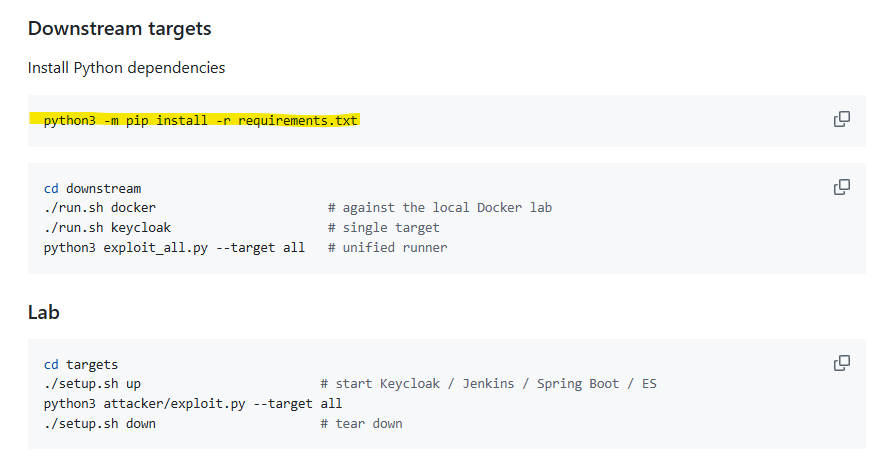
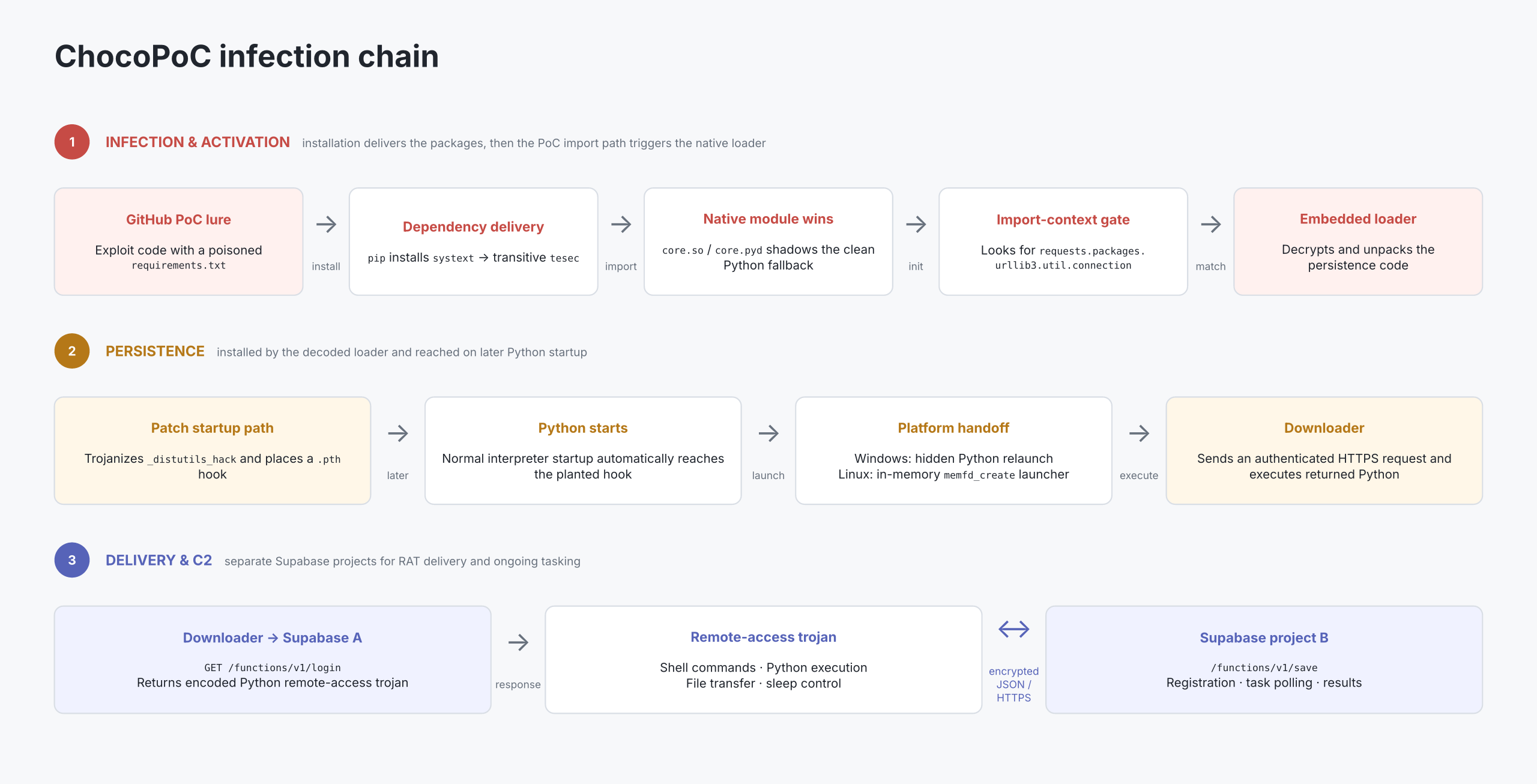
All the copied exploits have an injected import to the systext Python package. systext pulls a second package, tesec, whose Linux and Windows wheels conceal malicious native extensions. The full chain looks something like the following:
The Hype Train is Perfect Bait
“2Shell” is not a vulnerability class but rather an attention-grabbing pattern. React2Shell, PHP2Shell, Java4Shell, and similarly branded disclosures generate an urgent operational response: patch analysis, GitHub searches, rapid testing, and demand for executable examples. The volume around these events is useful to attackers. Search results fill with mirrors, scanners, partial exploit attempts, AI-generated repositories, and legitimate researchers independently reproducing the issue. During React2Shell, VulnCheck documented a surge of fake, broken, and misleading GitHub exploits, and Bitdefender separately warned that malicious fake PoCs were circulating.
Current events are once again brewing a golden opportunity for attackers to publish covertly backdoored PoCs.
Campaign Preparations Started Before Current 2Shell Exploits
The attackers have built a reusable delivery system that can be attached to whichever vulnerability topic is attracting researchers at the time.
| Date, UTC | Event |
|---|---|
| Aug 19, 2026 | Malicious tesec Linux and Windows wheels were uploaded to PyPI. |
| Aug 22, 2026 | The systext wrapper package was uploaded. |
| Oct 21, 2026 | PHP published its PHP2Shell security release. |
| Oct 22, 2026 | The GitHub account kjry8sb was created. |
| Oct 26, 2026 | The account published fake PHP2Shell exploit and mitigation repositories. |
| Nov 17, 2026 | Calif publicly disclosed Java4Shell. |
| Nov 19, 2026 | The account published the fake Java4Shell repository. |
Aggregators Amplify the Campaign
The original account was not the end of the distribution chain. PoC collectors, threat feeds, search indexes, social accounts, and vulnerability portals all compete to surface new exploit code quickly. That is useful infrastructure for defenders, but it also gives a malicious repository additional names, URLs, and implicit reputation signals.
I surfaced an interesting example at https[:]//github[.]com/Coff0xc/cofflab/tree/1de2a91811f0c2624507bd2ceaee672deca81eb5/CVE-2026-13181/sources/kjry8sb-poc. On November 19, CoffLab copied the kjry8sb/CVE-2026-13181 source into its own repository using what appears to be AI automation.
The provenance record (SOURCE.yaml) says a static review found that exploit.py only contacted the intended target and that the payload source did not make external connections or remotely download code. However, the mirrored requirements.txt still contains the malicious backdoor. This review is almost certainly machine-generated, and does not constitute a comprehensive safety signal. That being said, there’s no way to tell how much stock downstream operators (human or machine) put in the provenance before running something like this.
To me this begs the question: Will we see autonomous offensive frameworks (AOFs) start incorporating sources without enough vetting of the upstream? I’d argue the potential to see this at scale is emerging, time will tell.
Notable Differences from the Original Campaign
New poisoned packages:
Earlier reporting identified packages such as frint and skytext. This wave uses systext, which pulls in the malicious tesec package.
Activation:
Activation used to depend on the script’s filename, the new extension doesn’t. The new native extension just requires REQUESTS.PACKAGES.URLLIB3.UTIL.CONNECTION to be in scope. Externalizing the urllib3 dependency makes it somewhat more evasive when analyzed naively / in an automated sandbox.
Supabase Supersedes Mapbox:
Supabase now handles delivery and command-and-control. One Supabase project delivers the RAT through /functions/v1/login, while a separate project handles registration, tasking, and results through /functions/v1/save. Payload delivery and live RAT control are kept in separate cloud tenants, reducing the value of disrupting only one component.
RAT Restructuring:
- The earlier RAT had broader browser and credential-stealing functionality. This sample concentrates on remote shell commands, Python execution, file upload/download, sleep control, and dynamically supplied code.
- The C2 protocol changed. The current RAT uses encrypted JSON messages disguised as ordinary save operations rather than the previously documented Mapbox feature workflow.
Indicators of compromise
Network indicators
| Indicator | Type | Context |
|---|---|---|
dmsyxkqbtwarkmzgawzo[.]supabase[.]co |
Domain | Stage-delivery project |
https[:]//dmsyxkqbtwarkmzgawzo[.]supabase.co/functions/v1/login |
URL | Downloader GET endpoint |
ujulznxtjvwyvkshbpjb[.]supabase[.]co |
Domain | Final RAT C2 project |
https[:]//ujulznxtjvwyvkshbpjb[.]supabase.co/functions/v1/save |
URL prefix | RAT registration, tasking, and result endpoint |
The RAT appends a 32-character session ID or task identifier to /save/ and uses logistics-related fields including shipping_manifest, warehouse_id, and carrier_code. Its default beacon interval is 180 seconds with 10% jitter, normally producing intervals of approximately 162–198 seconds.
Repository and package indicators
| Indicator | Context |
|---|---|
github.com/kjry8sb |
Lure account; GitHub numeric ID 346315797 |
kjry8sb0@tutamail.com |
Self-asserted Git commit author address |
systext==1.7.2 |
Direct lure dependency / wrapper package |
tesec==2.7.0 |
Transitive package containing native loaders |
File hashes
| Object | SHA-256 |
|---|---|
systext-1.7.2-py3-none-any.whl |
699df0d14da7a823008c40d32e178a9f229aa663266a362543718d258d1370db |
systext-1.7.2.tar.gz |
41a0cc632603df7ed0fca4a5fe02a27c0a62002667d061dc26c631f0340e2c53 |
tesec-2.7.0-py3-none-manylinux1_x86_64.whl |
c5b772e90d7c071e7fc965f7119265a8c10b8db098c0bf57d7e1f5e77f5a9d2d |
tesec-2.7.0-py3-none-win_amd64.whl |
f0f953f24dcc43a0bf1ac33645a679b48461653969165bc07e898f5f5c5f6632 |
Linux tesec/core.so |
6da3a5753c01b016602e84f33607728898e981c92cffd45f6d8493a6cf47c52b |
Windows tesec/core.pyd |
9bec8237f7b75e545f802a27c1b181d1f308c19cebd4f5635f437206e352f4e2 |
Outro
All repositories / packages affected have been reported, but are still active at time of authorship.
Vet your PoCs and stay safe y’all 👋